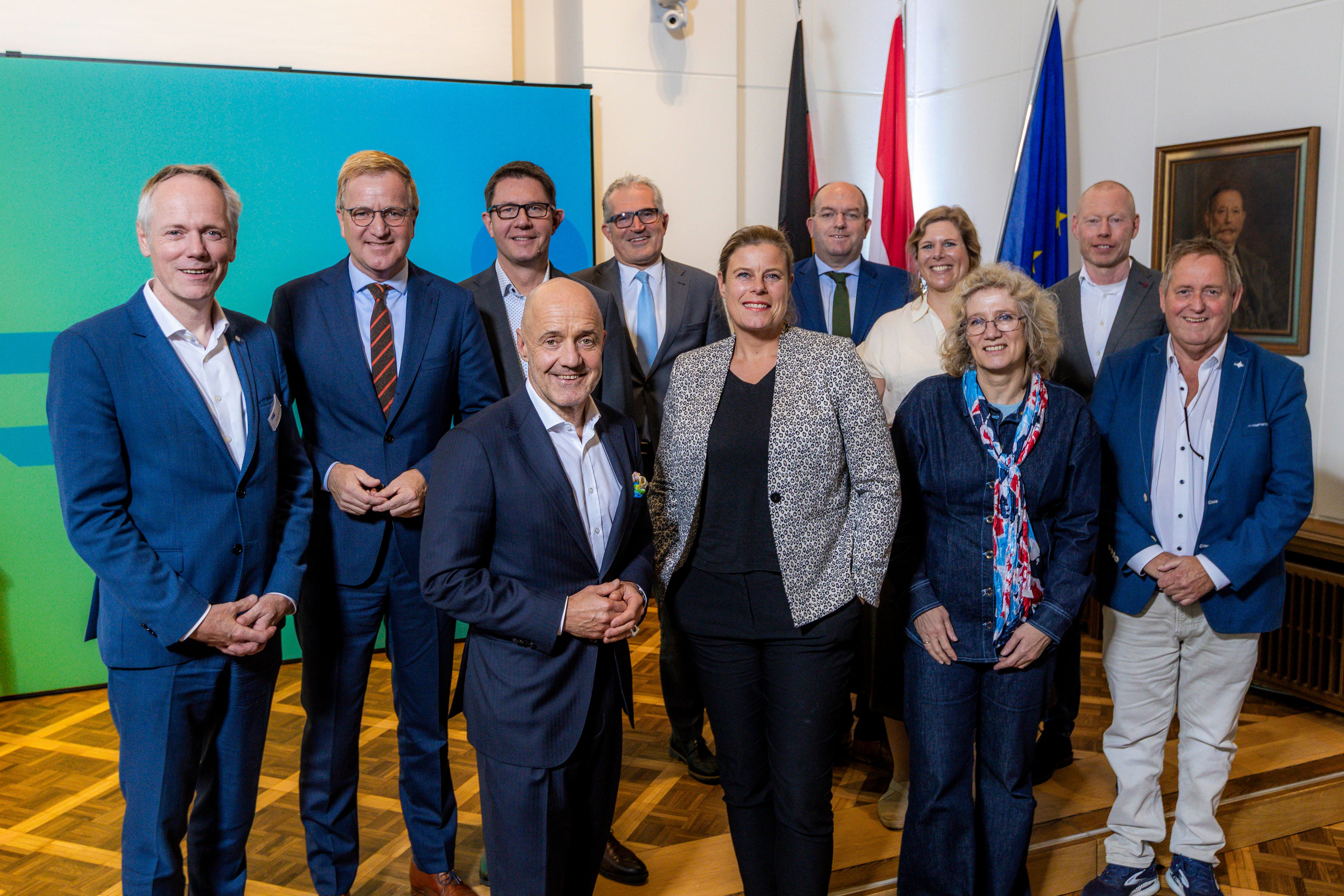
“Our businesses do not think in terms of national borders. They plan in terms of supply chains, markets and customer relationships. For this to succeed, they need transport routes and regulations that are tailored to these needs. Border controls represent isolation and hinder the movement of goods. Moreover, they pose an obstacle for commuters travelling from one place to another. We need simple and reliable processes within Europe,” emphasised Dr Stefan Dietzfelbinger, Managing Director of the Niederrheinische IHK, board member of the Euregio Rhine-Waal and Chair of the Economic Affairs Committee.
The Dutch Consul-General, Hannah Tijmes, emphasised how important a smooth flow of goods is for the economy. This requires largely unrestricted cross-border traffic. “An approach at border crossings that accommodates the various requirements that may be imposed on cross-border traffic is very welcome.”
Viktor Haase, State Secretary for Transport in Nordrhein-Westfalen, assured that the state is committed to reducing barriers: “A strong economic region needs transport routes that businesses can rely on every day. To this end, we are working daily to ensure faster planning and smooth construction. This is of crucial importance, particularly in the German-Dutch border region.”
Waterways must remain reliable
For industry, trade and logistics along the Lower Rhine, the waterway is a key factor in business location. Periods of low water levels clearly demonstrate that when ships can carry fewer loads or shipments are cancelled, businesses urgently need reliable alternatives by rail and road. Andreas Kochs, Secretary of the Euregio, made it clear: “For 55 years, the Euregio has been working to overcome borders in everyday life. This also applies to the economy. As a European waterway, the Rhine must function effectively in both Germany and the Netherlands.”
